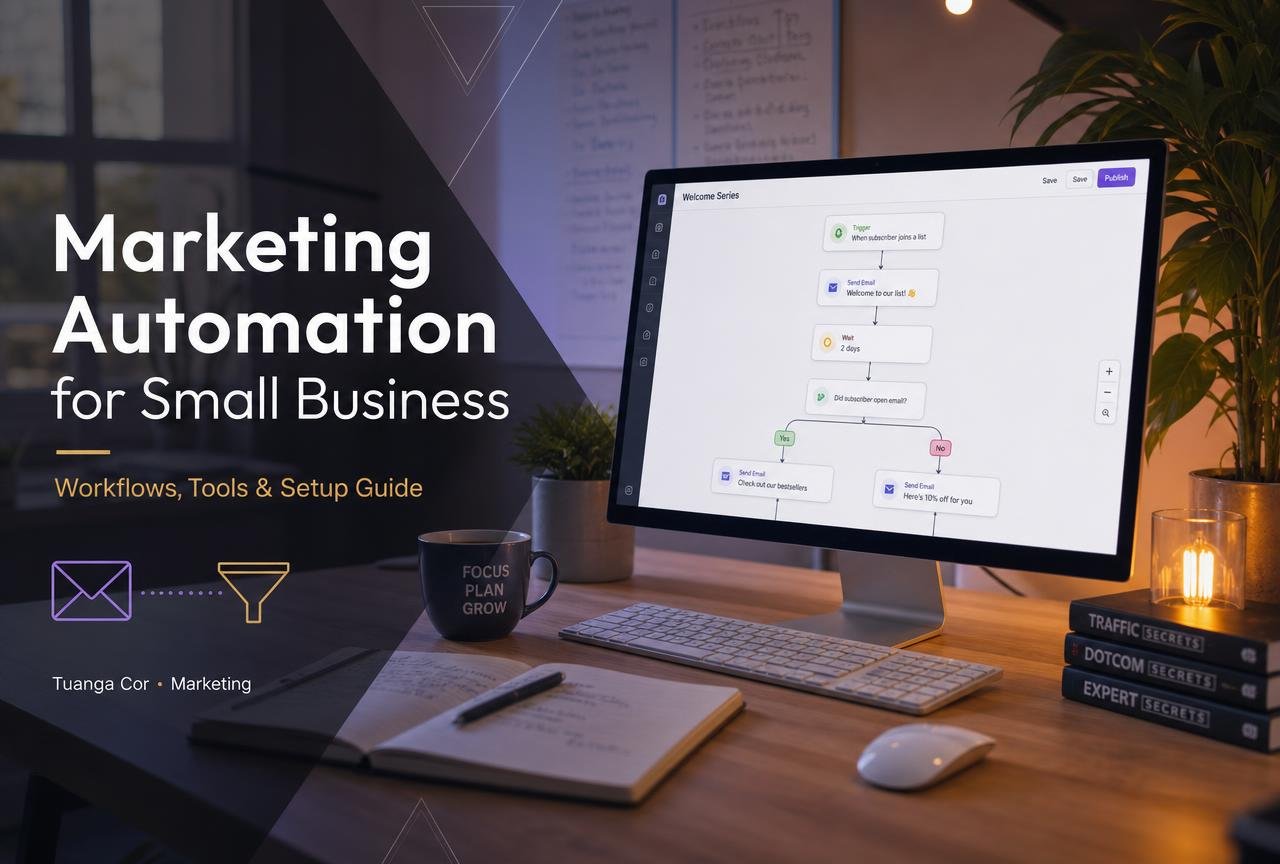
Best Email Marketing Software for Small Business
Deliverability, automations, and pricing at scale — the platforms worth your list in 2026.

Email remains the only marketing channel a small business actually owns. Social reach is rented, ad costs rise every year, and search results shift under your feet — but a permissioned email list is an asset that appears on no balance sheet and quietly outperforms everything else on return per pound, dollar or euro spent.
The catch is that "email marketing software" now describes three different products wearing the same label: simple newsletter tools, automation platforms built around customer journeys, and e-commerce revenue engines. Buying the wrong one is how businesses end up paying for 40,000 contacts to send four campaigns a year, or fighting a newsletter tool to build an abandoned-cart flow it was never designed for.
This guide compares the platforms small businesses in the US, UK, Canada and Australia most commonly shortlist — Mailchimp, Brevo, MailerLite, ActiveCampaign, Klaviyo and Kit — on deliverability, automation depth, pricing at real list sizes, and the specific job each is best at. It also covers list growth, compliance and the metrics worth reporting.
The three categories hiding behind one label
Before comparing prices, work out which product you are actually buying. Nearly every disappointing switch traces back to this step being skipped.
1. Newsletter and broadcast tools
Built for sending a well-designed message to a list on a schedule. Templates, segmentation, scheduling and reporting are strong; branching automation is basic. MailerLite and Kit sit here. If your model is "publish regularly, sell occasionally", this is the right category and the cheapest one.
2. Marketing automation platforms
Built around behaviour: what someone clicked, viewed, bought or ignored, and what should happen next. Multi-branch journeys, lead scoring, conditional content and CRM-style contact records. ActiveCampaign and Brevo live here, as does HubSpot. Choose this when the sale takes weeks and involves several touches.
3. E-commerce revenue platforms
Built to attribute revenue to messages. Deep product-catalogue sync, browse and cart abandonment, post-purchase flows, predictive lifetime value and SMS in the same journey. Klaviyo defines the category. If you run a store, the extra cost is usually recovered inside a quarter — the flows are that reliable.
Best email marketing software compared
List prices below are taken from each vendor's public pricing page and modelled at 5,000 contacts with unlimited or generous sending, billed monthly. Pricing in this category changes frequently, so confirm before purchase — particularly the contact-count band you fall into, which is where the real cost lives.
| Platform | Best for | ~Cost at 5,000 contacts | Free plan | Automation depth | E-commerce revenue tracking |
|---|---|---|---|---|---|
| MailerLite | Clean newsletters on a budget | ~$39/mo | 1,000 contacts | Moderate | Basic |
| Brevo | Send-volume pricing, transactional + marketing | ~$29/mo (by sends) | 300 emails/day | Good | Good |
| Mailchimp | All-rounder with the widest integrations | ~$75/mo | Limited | Good | Good |
| ActiveCampaign | Complex B2B journeys and lead scoring | ~$79/mo | No | Excellent | Good |
| Kit (ConvertKit) | Creators, courses, paid newsletters | ~$79/mo | 10,000 contacts, limited | Moderate | Digital products |
| Klaviyo | Online stores chasing revenue per recipient | ~$100/mo | 250 contacts | Excellent | Best in class |
MailerLite — the value winner for straightforward sending
MailerLite does the fundamentals unusually well: a genuinely pleasant drag-and-drop editor, fast landing pages, clean forms and reliable delivery, all at roughly half the price of the better-known alternatives. The free tier covers 1,000 subscribers with 12,000 monthly sends, which is enough to build an audience before spending anything.
Limitations: automations are linear rather than deeply conditional, and approval for new accounts can be strict — affiliate-heavy senders are frequently declined. Reporting is adequate rather than analytical.
Brevo — priced by sends, not contacts
Brevo (formerly Sendinblue) bills primarily on emails sent rather than contacts stored, which flips the economics for businesses with large lists they email infrequently. It also combines marketing and transactional email in one account, so receipts, password resets and campaigns share a reputation and a dashboard. SMS and WhatsApp are built in, useful in markets where those channels convert.
Limitations: the template editor is less refined than MailerLite's, and the interface carries the seams of a platform that has expanded quickly into CRM and chat.
Mailchimp — the default, and still a reasonable one
Mailchimp's advantage is ubiquity: whatever tool you use, there is a Mailchimp integration, and every freelancer you hire already knows it. Deliverability is strong, the content studio and templates are polished, and its reporting benchmarks against industry averages, which is genuinely useful context for a small sender.
Limitations: price. Mailchimp counts unsubscribed and non-subscribed contacts toward your plan depending on tier, and costs climb steeply past 10,000 contacts. Its own pricing page is the only reliable source, as bands change often. Teams that grow fast frequently migrate away on cost alone.
ActiveCampaign — the automation specialist
If your customer journey has genuine branches — different sequences by industry, lead score thresholds, sales handoffs, re-engagement paths — ActiveCampaign is the most capable tool a small business can realistically operate. The visual automation builder handles conditional logic that others simply cannot express, and the built-in CRM means marketing and sales work from one record.
Limitations: it is a professional tool with a professional learning curve, and pricing rises with both contacts and features. Overkill for a monthly newsletter.
Kit — built for people who publish
Kit optimises for creators: plain-text-feeling emails that land in the primary inbox, tag-based subscriber management rather than rigid lists, a strong recommendation network for list growth, and native paid-newsletter and digital-product selling. If your business is expertise-led — courses, consulting, membership — it fits the way you actually work.
Klaviyo — the e-commerce revenue engine
Klaviyo's product-catalogue integration with Shopify, WooCommerce and BigCommerce is the deepest available, and its reporting attributes revenue to individual flows and messages rather than to email as a vague whole. Abandoned cart, browse abandonment, post-purchase, replenishment and win-back flows ship as templates that work on day one. Costs more; typically pays for itself in the first quarter for stores doing meaningful volume. If you are still choosing a storefront, pair this with our guide to the best e-commerce platform for small business.
Deliverability: the only metric that makes the others possible
An email that lands in spam has a 0% open rate regardless of how good the subject line was. Since Google and Yahoo tightened bulk-sender requirements, authentication is no longer optional for anyone sending more than a few thousand messages a month, and it is the first thing to fix.
The authentication checklist
- SPF — a DNS record listing which servers may send on your domain's behalf.
- DKIM — a cryptographic signature proving the message was not altered in transit.
- DMARC — a policy telling receiving servers what to do when SPF or DKIM fails, plus reporting so you can see who is sending as you.
- A one-click unsubscribe header, required by major mailbox providers for bulk senders.
- A spam complaint rate below 0.3%, measured over a rolling window. Above that, delivery degrades quickly.
Every platform in this guide walks you through SPF and DKIM setup; none can fix a bad sending habit. Google's email sender guidelines are the definitive reference and are updated more often than most vendor documentation.
The habits that protect the list
- Never buy or scrape a list. One purchased list can permanently damage a domain's reputation, and it is illegal under UK GDPR and Canada's CASL without consent.
- Use double opt-in for public forms. You will lose 15–25% of signups and gain a list that opens.
- Send from a subdomain (news.yourdomain.com) so a marketing mishap cannot harm the reputation of your invoices and quotes.
- Warm up gradually when switching platforms — start with your most engaged 20% and expand over two weeks.
- Prune ruthlessly. Suppress anyone who has not opened in 180 days after one re-engagement attempt. A smaller engaged list outperforms a large dormant one and costs less to store.
Six automations worth building before your next campaign
Broadcasts earn attention. Automations earn money while you sleep. Build these in order; each takes under an hour and keeps working indefinitely.
- Welcome sequence (3–5 emails). Sent over ten days from signup. Highest engagement window you will ever get. Deliver the promised value first, sell third.
- Abandoned cart or abandoned enquiry (3 emails). For stores, the single highest-revenue flow. For service businesses, the equivalent is a quote sent but not accepted after 48 hours.
- Post-purchase or post-project sequence. Delivery confirmation, a usage tip, then a review request timed to when value has actually been experienced.
- Lead nurture by interest. Tag on the link clicked or form completed, then send the sequence matching that interest. This is where tag-based platforms beat list-based ones.
- Re-engagement. Two messages to anyone dormant for 120 days, then suppress. Protects deliverability and reduces your bill.
- Replenishment or renewal reminders. Timed to consumption or contract dates. For subscription businesses, pair with the retention tactics in our subscription billing guide.
Teams running longer, multi-channel journeys should read our deeper marketing automation for small business guide, which covers scoring, sales handoff and workflow governance.
Growing a list that is worth emailing
List size is a vanity metric; engaged list size is the business one. These tactics reliably produce subscribers who open.
- Offer a specific, immediately useful asset. "Join our newsletter" converts around 1%. A named, practical resource — a checklist, template or pricing calculator relevant to a single problem — routinely converts 5–10% of relevant traffic.
- Match the offer to the page. A visitor reading about invoicing should be offered an invoicing template, not a generic guide. Platform-native forms make per-page offers trivial.
- Use exit intent sparingly on desktop and never as an immediate mobile interstitial — Google treats intrusive interstitials as a negative ranking signal on mobile.
- Convert existing customers deliberately. Add a checkbox at checkout and in your onboarding forms, with clear separate consent for marketing.
- Run partner swaps with complementary non-competing businesses. Two thousand aligned subscribers beat twenty thousand strangers.
Consent and compliance, briefly
Rules differ by market and the penalties are real. Under UK and EU GDPR you need a lawful basis and clear affirmative consent for most marketing email. Canada's CASL requires express or clearly documented implied consent with defined expiry. Australia's Spam Act requires consent, identification and a functional unsubscribe. The US CAN-SPAM Act permits sending without prior consent but mandates a valid postal address and honouring opt-outs within ten business days. Record where, when and how each subscriber consented — every platform here stores this, and it is your only defence in a complaint.
The five numbers to report, and the ones to ignore
Most email dashboards drown a small business in metrics. Report these five monthly and you will make better decisions than any agency deck.
| Metric | What it tells you | Healthy range (SMB) |
|---|---|---|
| Click-through rate | Whether the content earned action | 2–5% of delivered |
| Conversion rate | Whether the offer matched the audience | 1–3% of clicks to goal |
| Revenue per recipient | The only number that scales with the list | Track trend, not absolute |
| List growth rate net of churn | Whether acquisition beats fatigue | Positive every month |
| Spam complaint rate | Early warning on deliverability | Below 0.1% |
Ignore raw open rate as a performance measure, total subscriber count as a success metric, and any benchmark that averages across industries with wildly different buying cycles. Compare your campaigns to your own previous campaigns; that is the only fair comparison available.
Switching platforms without losing your list
Most businesses change email platforms twice in their first five years — usually on price, occasionally on automation limits. Done carelessly, a migration costs you deliverability for a month. Done in this order, it costs a weekend.
- Export everything first: contacts with tags, custom fields, consent timestamps and source, plus your automation logic documented as a flowchart. Exports rarely carry automations.
- Segment before importing. Import engaged contacts (opened or clicked in 90 days) as one group and the rest as another. You will send to the first group only for the first two weeks.
- Authenticate the new platform — SPF, DKIM, DMARC and a dedicated sending subdomain — before the first send.
- Warm up over 10–14 days, starting at roughly 20% of your engaged list and increasing volume daily while watching bounce and complaint rates.
- Rebuild automations manually and test each with a real address before enabling. Silent broken flows are the most expensive migration error.
- Keep the old account open for 30 days in read-only form so you can retrieve historical reporting.
The verdict: choosing by business model, not feature count
- You publish regularly and sell occasionally → MailerLite. Best editor-to-price ratio available.
- You have a large list you email infrequently → Brevo, because send-based pricing matches your usage.
- You want one familiar tool with every integration → Mailchimp, with a calendar reminder to review costs at 10,000 contacts.
- Your sale takes weeks and has branches → ActiveCampaign.
- You are the product — courses, consulting, membership → Kit.
- You run an online store → Klaviyo, without much hesitation.
Whichever you pick, the platform is maybe 20% of the outcome. The other 80% is a list that opted in, a welcome sequence that delivers on its promise, and the discipline to prune contacts who stopped listening. Get those right and every tool on this list will make you money.
Frequently asked questions
What is the best email marketing software for a small business?
It depends on the job. MailerLite is the best value for straightforward newsletters, Brevo suits large lists emailed infrequently because it prices by sends, ActiveCampaign is strongest for branching B2B journeys, and Klaviyo is the clear choice for online stores that need revenue attribution per flow.
How much does email marketing software cost at 5,000 contacts?
Roughly $29–$40 per month for MailerLite or Brevo, $75–$80 for Mailchimp, ActiveCampaign or Kit, and around $100 for Klaviyo. Costs rise in bands as your contact count grows, so always model your expected list size in twelve months rather than today's.
Is a free email marketing plan enough to start?
Yes, for the first thousand subscribers. MailerLite's free plan covers 1,000 contacts and 12,000 monthly emails, Brevo allows 300 emails a day with unlimited contacts, and Kit's free tier reaches 10,000 subscribers with limited features. Upgrade when you need automation branching or higher volume.
Why do my marketing emails land in spam?
Most commonly because SPF, DKIM and DMARC records are missing or misconfigured, because the list contains addresses that never opted in, or because complaint rates exceed 0.3%. Fix authentication first, send from a dedicated subdomain, and suppress contacts who have not engaged in six months.
What is a good open rate for small business email in 2026?
Reported open rates of 25–40% are typical, but Apple Mail Privacy Protection inflates them by pre-loading images. Treat opens as a rough trend only, and judge performance on click-through rate (2–5% is healthy), conversions and revenue per recipient.
Do I need consent before emailing business contacts?
In the UK and EU you need a lawful basis and normally clear affirmative consent, with a narrow legitimate-interest route for some B2B contacts. Canada's CASL and Australia's Spam Act both require consent. The US CAN-SPAM Act allows sending without prior consent but requires a valid postal address and prompt opt-out handling.
Which email automation should I build first?
A three-to-five message welcome sequence. It reaches subscribers during their highest engagement window, sets expectations for frequency and content, and typically produces more revenue per recipient than any broadcast campaign you will send that year.
How do I switch email platforms without hurting deliverability?
Export contacts with consent timestamps and tags, set up SPF, DKIM and DMARC on the new platform before sending, then warm up over ten to fourteen days starting with your most engaged 20% of subscribers. Rebuild and test every automation manually, and keep the old account readable for 30 days.
Email marketing, automation, SEO, analytics and branding tools reviewed for growing SMBs.